
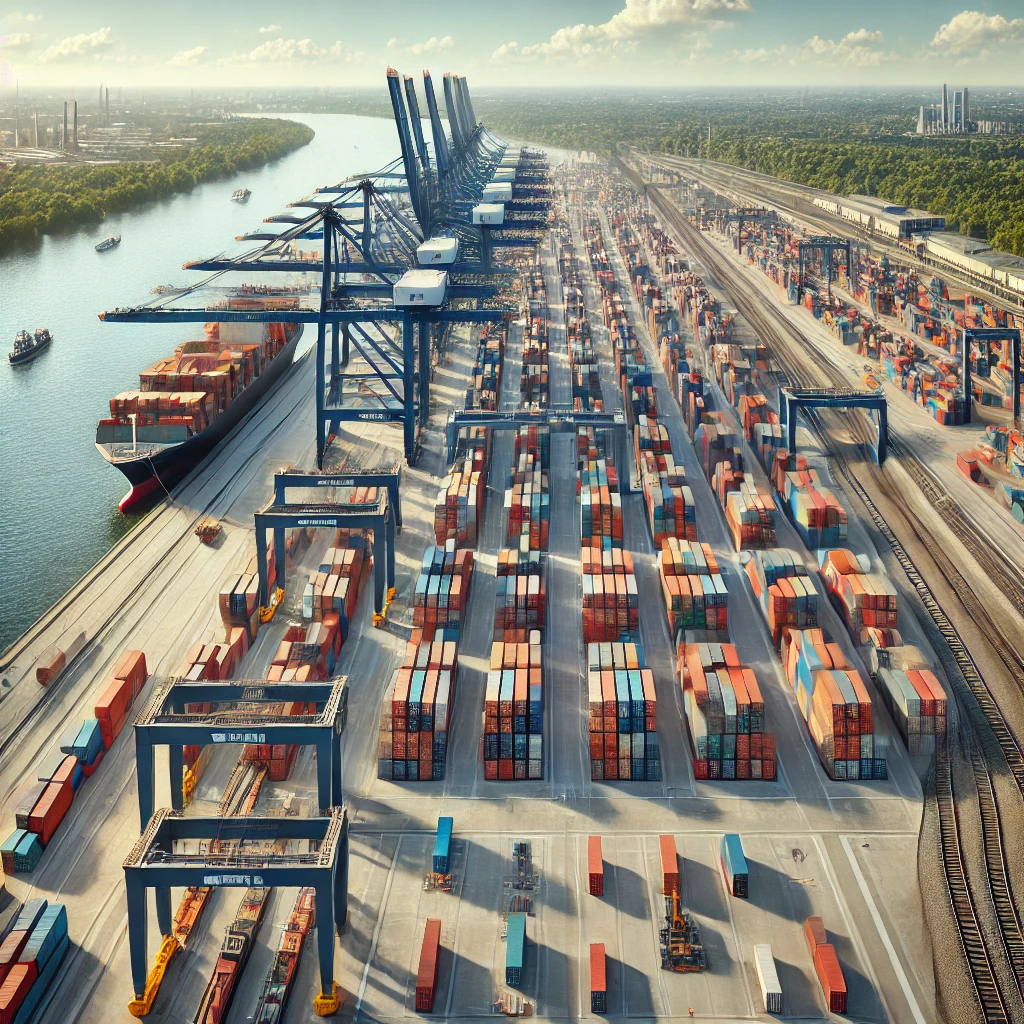
Containers instead of coal: Duisburg Gateway Terminal goes live
The Duisburg Gateway Terminal (DGT) has commenced operations, marking a significant milestone for freight transport in Europe. A state-of-the-art container terminal is now being built on the former site of the Duisburg coal port, which served for decades as a transshipment point for fossil fuels. This will further advance the structural transformation of the Ruhr region by ensuring the area's sustainable use for freight transport.
A milestone for European freight transport
The DGT is not only the largest terminal of its kind in Europe, but also a central hub for the Silk Road connections between Europe and China. With the terminal's commissioning, Duisburg's role as a logistics hub will be strengthened, particularly for trade along the "New Silk Road." The terminal's capacity is impressive: an annual throughput of up to 850,000 containers is targeted.
Sustainability in focus
A key feature of the Duisburg Gateway Terminal is its focus on sustainability. The entire facility is designed to be emission-free and is powered exclusively by electricity. Cranes, forklifts, and other technical equipment operate without emissions to significantly reduce CO₂ emissions. Furthermore, there are plans to operate the terminal entirely on renewable energy, making a significant contribution to environmental protection and the project's sustainability.
Cooperation and technological innovation
The Duisburg Gateway Terminal was made possible through the collaboration of several strong partners. Companies such as Duisburger Hafen AG (duisport), Hupac, and COSCO contributed their expertise to create an innovative and future-oriented logistics center. In addition to its handling capacity, the terminal also offers numerous digital services to make container traffic more efficient and transparent.
Impulses for the regional economy
The new terminal is not only important for international trade, but also a key driver of the regional economy. It creates jobs and provides companies in the Ruhr region with a high-performance infrastructure for freight transport. Thanks to its connections to rail, road, and waterways, the DGT is exceptionally well-connected and offers optimal conditions for the transshipment and onward transport of goods.
Future prospects
The commissioning of the Duisburg Gateway Terminal (DGT) marks an important step in the transformation of the Ruhr region into a sustainable and future-oriented economic area. The importance of coal is declining, while freight transport and the logistics sector are gaining in significance. Through the combination of modern technology, emission-free operation, and a strategic location, the DGT will remain a key player in international trade.
More information about Duisburg Gateway Terminals can be found via the links.
Source: NMWP.NRW
